
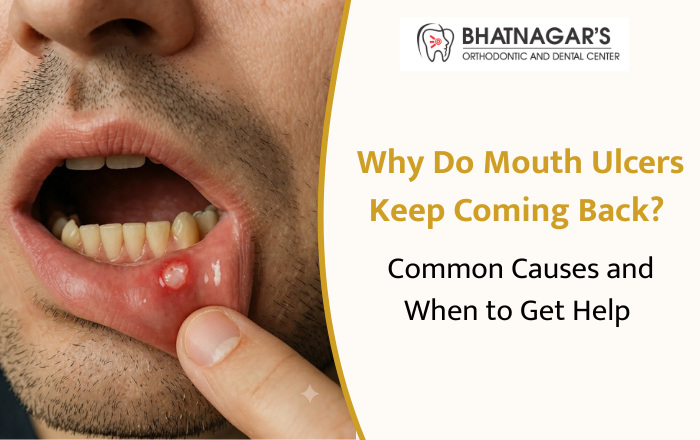
One mouth ulcer now and then is usually nothing to worry about. But when a new sore appears just as the last one heals, it starts to affect how you eat, talk and sleep. Many people live with recurring mouth ulcers for years, trying one gel after another without knowing what sets them off.
Here is why mouth ulcers keep coming back, what helps at home, and which signs mean you should get your mouth checked.
What Are Recurring Mouth Ulcers?
Recurring mouth ulcers are painful sores inside the mouth that keep coming back, often in similar places. The most common type is recurrent aphthous stomatitis, also called canker sores.
They are usually round or oval, with a white or yellow centre and a red border, and appear on the inner cheeks, lips, tongue or gums. They are not contagious and are different from cold sores, which form on or around the lips.
Most heal within one to two weeks. The NHS guidance on mouth ulcers advises seeing a dentist or doctor if an ulcer lasts longer than 3 weeks.
Why Do Mouth Ulcers Keep Coming Back?
Mouth ulcers keep coming back when the trigger behind them is still present. Often more than one trigger is involved.
1. Repeated Injury Inside the Mouth
Small injuries are one of the most frequent triggers:
- Biting your cheek or tongue
- Brushing too hard or using a hard bristled toothbrush
- A sharp or broken tooth, or a rough or worn dental filling
- Braces wires or dentures that rub against the cheek
- Burns from very hot tea or food
An ulcer that keeps forming at the same spot often points to a sharp edge or rubbing appliance.
2. Vitamin and Mineral Deficiencies
Low levels of vitamin B12, iron, folic acid or zinc are linked with repeated ulcers. A simple blood test can show whether a deficiency is part of the picture.
3. Stress, Poor Sleep and Hormonal Changes
Ulcers often appear during exams, deadlines or after poor sleep. Some women get them around their periods or during pregnancy, which points to a hormonal link.
4. Food Triggers and Toothpaste
Very spicy or salty food, acidic fruits, chocolate, coffee and crunchy snacks can set off ulcers in sensitive people. Some people also react to sodium lauryl sulphate (SLS), a foaming agent in many toothpastes.
5. Family History and Medicines
Recurring ulcers can run in families. Some medicines, such as certain painkillers (NSAIDs) and beta blockers, can also cause them, and some people notice ulcers for a while after they stop smoking.
6. Underlying Health Conditions
Sometimes repeated ulcers point to a condition elsewhere in the body, such as:
- Coeliac disease or Crohn’s disease
- Oral lichen planus
- Behçet’s disease or lupus
- A weakened immune system
What Can You Do at Home to Reduce Flares?
You can often reduce how often ulcers appear by removing the triggers you can control.
- Switch to a soft toothbrush and brush gently.
- Try a toothpaste without SLS for a few weeks.
- Keep a simple diary of food, stress and sleep each time an ulcer appears.
- Eat a balanced diet with green leafy vegetables, dals and dairy.
- Avoid very hot, spicy or acidic foods while an ulcer heals.
- Rinse with warm salt water to keep the area clean.
For more ways to ease an active sore, read our guide on getting quick relief from painful mouth sores. Avoid taking high dose vitamin supplements without first confirming a deficiency.
When Should You See a Doctor for Mouth Ulcers?
See a dentist or oral physician if an ulcer lasts longer than 3 weeks, or if ulcers keep returning several times a year.
Get your mouth checked if you notice:
- An ulcer that has not healed in 3 weeks
- Ulcers that return more than 2 or 3 times a year
- An ulcer that is larger than usual, has hard edges or looks different from your usual ones
- A red or white patch in the mouth that does not go away
- Ulcers along with fever, tiredness, diarrhoea or a skin rash
- Difficulty swallowing, or an ulcer that bleeds or keeps getting worse
Most mouth ulcers are harmless. However, an ulcer that does not heal can sometimes be an early sign of mouth cancer, so it should never be ignored, especially if you use tobacco, gutkha or areca nut.
How Are Recurring Mouth Ulcers Diagnosed and Treated?
A doctor first examines the ulcers and asks about your health, diet, habits and medicines. This may be followed by blood tests for deficiencies, and a biopsy in certain cases if an ulcer looks unusual or does not heal.
Treatment then depends on the cause and may include:
- Topical gels or pastes to reduce pain and inflammation
- Medicated mouthwashes to keep the area clean
- Supplements, if tests confirm a deficiency
- Smoothing sharp teeth or adjusting dental appliances
- Prescription medicines for severe or frequent ulcers
The MedlinePlus page on canker sores notes that sores which persist or keep returning may need tests for other causes. Please do not use steroid gels or tablets without a prescription. Every patient is different, so results vary from person to person.
Frequently Asked Questions
1. Are recurring mouth ulcers a sign of cancer?
In most cases, no. Ulcers that come and go and heal within one to two weeks are usually aphthous ulcers, which are not cancerous. However, an ulcer that does not heal within 3 weeks, or a red or white patch that stays, should be checked by a doctor, especially if you use tobacco or areca nut.
2. Which vitamin deficiency causes mouth ulcers?
Low levels of vitamin B12, iron, folic acid and zinc are the deficiencies most often linked with mouth ulcers. Not everyone with ulcers has a deficiency, though. A blood test can confirm whether your levels are low, so your doctor can suggest the right supplement and dose instead of you guessing.
3. Can stress make mouth ulcers keep coming back?
Yes, stress is a common trigger, and many people notice new ulcers during exams or busy work periods. It is rarely the only cause, so it helps to look at diet, oral habits and general health too. Regular sleep and meals on time may help reduce flares for some people.
4. How long does a mouth ulcer take to heal?
Most minor mouth ulcers heal on their own within 7 to 14 days. Larger ulcers can take a few weeks and may leave a small scar. If an ulcer has not healed within 3 weeks, keeps getting bigger or is very painful, see a dentist or oral physician for a proper check.
5. Should I see a dentist or an oral physician for repeated ulcers?
You can start with either. A dentist can check for sharp teeth, rough fillings or appliances that injure the mouth. An oral physician has specialised training in diseases of the mouth lining and can investigate ulcers that keep returning, and may coordinate with your physician if a general health condition is suspected.
Get Recurring Mouth Ulcers Checked by an Oral Physician
If ulcers keep interrupting your meals and sleep, you can consult Dr. Dipti Bhatnagar, Oral Physician (MDS, Oral Medicine and Radiology) with 26 years of experience, at Bhatnagar’s Orthodontic and Dental Centre, Chandigarh. The clinic evaluates recurrent oral ulcers and other conditions of the mouth lining. You can also read about our approach to treating mouth ulcers before your visit.
Phone: 95188 31269
Address: Hno. 3512, Sector 38-D, Sector 38, Chandigarh, 160014
View our clinic on Google | Book an appointment
Recent Post


Services
