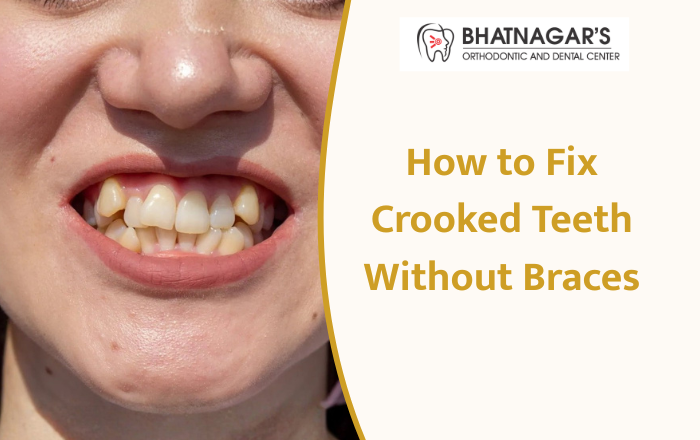
Crooked teeth are common, but many people hesitate to straighten them because they do not want traditional metal braces. The good news is that some crooked teeth can be corrected without traditional braces, depending on the position of the teeth, amount of crowding, bite, and overall orthodontic problem.
Options such as clear aligners can move teeth gradually without using conventional brackets and wires. However, they are not suitable for every case. Some patients may need fixed orthodontic treatment or another approach to achieve proper tooth movement and bite correction.
So, how can you fix crooked teeth without braces? Let’s look at the available options and what you should know before choosing one.
Can Crooked Teeth Be Fixed Without Traditional Braces?
Yes, in selected cases, crooked teeth can be corrected without traditional braces. Clear aligners are one of the most common alternatives to braces for crooked teeth.
However, treatment depends on the underlying problem. A dentist or orthodontist needs to assess:
- How crooked or crowded the teeth are
- The position and rotation of individual teeth
- Whether there are gaps between teeth
- How the upper and lower teeth meet
- Whether there is an overbite, underbite, or crossbite
- The health of the teeth and gums
- Whether tooth movement is required for cosmetic or functional reasons
A treatment that works well for mild crowding may not be appropriate for a more complex bite problem.
Why Do Teeth Become Crooked?
Teeth can become crooked for several reasons. Sometimes it is mainly related to genetics, while other factors can contribute to changes in tooth position.
Common causes include:
- Lack of sufficient space in the jaw
- Smaller or differently shaped jaws
- Teeth that are larger than the available space
- Early loss of baby teeth
- Delayed loss of baby teeth
- Certain childhood habits, such as prolonged thumb sucking
- Missing teeth
- Changes in tooth position over time
- Not wearing a retainer after previous orthodontic treatment
Crooked teeth are therefore not always simply a cosmetic issue. In some people, crowding can make brushing and flossing more difficult or occur alongside a bite problem.
How to Straighten Crooked Teeth Without Braces
1. Clear Aligners
Clear aligners are a popular option for people who want orthodontic treatment without traditional braces.
They are removable, transparent trays designed to apply controlled pressure to the teeth. A series of aligners is typically used, with each set gradually moving the teeth toward planned positions.
Clear aligners may be considered for certain cases involving:
- Mild to moderate crowding
- Small gaps between teeth
- Some types of tooth rotations
- Certain bite problems
- Minor tooth alignment issues
One of the main advantages is that aligners are less noticeable than conventional braces and can generally be removed for eating, drinking, brushing, and flossing.
However, clear aligners are not a universal solution. More complex tooth movements or significant bite problems may require other orthodontic approaches.
2. Ceramic Braces
If your concern is mainly about the appearance of metal braces, ceramic braces may be another option to discuss.
Ceramic braces work using the same basic orthodontic principle as traditional braces. Brackets are attached to the teeth and controlled forces are used to move them.
Because the brackets can be tooth-coloured or relatively less noticeable, some people prefer them for cosmetic reasons.
They are not a completely brace-free treatment, but they may provide an alternative to conventional metal braces when fixed orthodontic treatment is required.
3. Cosmetic Dental Treatments
Some dental procedures can change the appearance of slightly uneven or misshapen teeth without actually moving them.
Depending on the situation, options may include:
- Dental bonding
- Veneers
- Tooth reshaping
These treatments can alter the shape or appearance of a tooth, but they should not be confused with orthodontic tooth movement.
For example, a veneer may make a mildly uneven tooth appear straighter, but it does not correct the underlying position of the tooth or necessarily address a bite problem.
A dental professional should determine whether a cosmetic approach is appropriate for your teeth and gums.
Which Crooked Teeth Can Be Treated With Clear Aligners?
Clear aligners may work well when the orthodontic problem is within the range that aligners can predictably manage.
They may be considered when there is:
- Mild or moderate crowding
- Minor spacing
- Certain cases of crooked front teeth
- Some bite irregularities
- Relatively straightforward tooth movements
However, suitability cannot be determined simply by looking at photographs or comparing your teeth with someone else’s treatment.
Some cases involve tooth movements that are more difficult to achieve with aligners alone. Significant crowding, complicated rotations, severe bite discrepancies, impacted teeth, or other orthodontic problems may require a different treatment plan.
When Might Braces Still Be Necessary?
Not every case of crooked teeth can be treated with clear aligners or cosmetic procedures.
Traditional or other fixed orthodontic treatment may still be recommended when there is:
- Significant crowding
- Complex tooth movement
- Severe bite problems
- Impacted teeth
- Major rotations of certain teeth
- Problems involving the relationship between the upper and lower jaws
- A need for more controlled movement of particular teeth
In some situations, different orthodontic techniques may also be combined as part of the treatment plan.
The goal should not simply be to make the front teeth look straighter. Proper orthodontic treatment also considers the bite, tooth function, gum health, and long-term stability.
Is It Possible to Straighten Teeth Naturally?
There is no reliable natural method that can safely move significantly crooked teeth into the correct orthodontic position.
Trying to push, press, or apply homemade devices to teeth can potentially damage the teeth or gums. Similarly, using an unapproved tooth-straightening product without professional supervision can result in unwanted tooth movement.
Orthodontic tooth movement should be planned and monitored by a qualified dental professional.
What Should You Consider Before Choosing a Treatment?
Before deciding between aligners, braces, or a cosmetic procedure, consider the actual cause and severity of your dental problem.
A professional assessment can help answer:
- Do my teeth actually need orthodontic movement?
- Is my case suitable for clear aligners?
- Do I have a bite problem in addition to crooked teeth?
- Would a cosmetic treatment address my concern, or would it only change appearance?
- What type of retention will I need after treatment?
This assessment is particularly important because the most discreet option is not necessarily the appropriate option for every patient.
How Long Does It Take to Straighten Crooked Teeth Without Braces?
There is no single treatment time for crooked teeth. It depends on the amount and type of tooth movement required, the treatment method, and how consistently the treatment instructions are followed.
Clear aligner treatment, for example, usually involves wearing a sequence of trays according to the orthodontist’s instructions and attending follow-up appointments to monitor progress.
Your orthodontist can provide a more meaningful estimate after examining your teeth and bite.
Frequently Asked Questions
1. Can I fix crooked teeth without metal braces?
Yes. Some cases can be treated with clear aligners or other orthodontic approaches. The appropriate option depends on the severity and type of tooth and bite problem.
2. Are clear aligners suitable for everyone?
No. Clear aligners can treat many types of alignment problems, but some complex cases may require fixed braces or other orthodontic treatment.
3. Can veneers fix crooked teeth?
Veneers can change the appearance of certain teeth and may make mildly uneven teeth look straighter. They do not actually move teeth into a new orthodontic position.
Get Your Teeth Assessed Before Choosing a Treatment
If you want to straighten crooked teeth without traditional braces, there are several possible approaches, but the right choice depends on your individual teeth and bite. Clear aligners can be an effective option for selected cases, while more complex orthodontic problems may require other treatment methods.
For an individual assessment and guidance on suitable teeth straightening options, you can consult Bhatnagar’s Orthodontic & Dental Centre, led by Dr. Deepankar Bhatnagar, Consultant Orthodontist, M.D.S., with 25+ years of experience.
For WhatsApp consultation, click here:
WhatsApp consultation
Phone: 95188 31269
Address: Hno. 3512, Sector 38-D, Sector 38, Chandigarh, 160014
Recent Post




Services
